
Special Care
Massage during cancer treatment: comfort, with caution
Trials hint that massage eases mood, pain and sleep during cancer care — weakly. The real difference is a therapist who knows exactly what to avoid.
The short answer
Massage may ease mood, pain and sleep during cancer care, but evidence is modest — a 2016 Cochrane review of 19 studies rated it very low quality. A session of 45 to 60 minutes can be safe with an oncology-trained therapist who adapts pressure and avoids tumor sites, wounds and clot risk. Clear it with your oncology team first.
- pooled in the 2016 Cochrane review on cancer pain
- 19 studies
- across those trials — evidence still rated very low
- 1,200+ patients
- behind the SIO's grade-B recommendation for mood
- 6 trials
- in a second 2016 review offering only weak recommendations
- 16 studies
- of U.S. adults used massage therapy in 2022 (NCCIH)
- 10.9%
- plus D.C. license massage therapists before they practice
- 45 states
A common therapy, used in an uncommon situation
In 2016 a Cochrane review pooled 19 mostly small studies and more than 1,200 cancer patients to ask whether massage relieves pain and anxiety. Some of those studies hinted that it did. But the quality of the evidence was very low, some trials may have been biased, and the results did not line up. That is roughly where the science still sits: massage during cancer treatment is plausibly helpful for how a person feels, weakly supported by trials, and safe only when a trained therapist knows exactly what to avoid touching. The distance between "people feel better" and "trials prove it works" runs through everything below — and the precautions are not optional niceties.
Massage itself is mainstream. NCCIH reports that 10.9 percent of U.S. adults used massage therapy in 2022, more than double the 4.8 percent who used it in 2002 — a rate that more than doubled across the 20 years between those two surveys. The term covers at least 4 broad families of technique: the most common form in Western countries is Swedish, or classical, massage, which forms the core of most training programs; others include sports massage, clinical massage aimed at specific goals such as releasing muscle spasms, and traditions derived from Eastern practice such as Shiatsu and Tuina. People have reached for some version of it across most cultures throughout history, and it was among the earliest tools used to relieve pain.
That popularity is worth keeping in mind, because the version of massage marketed to a general spa client is not automatically the version a cancer patient should receive. The technique that loosens a desk worker's shoulders is the same technique that becomes a hazard over a fresh surgical site or a fragile bone. The setting also does real work that the strokes alone do not: Mayo Clinic notes that massage usually happens in a quiet, pleasant space, often with aromatherapy and music, and that this environment is part of why it helps people relax. For someone in treatment, getting the benefit while skipping the risk depends almost entirely on who is in the room and what they know about your body.
What the evidence actually supports
Mayo Clinic states the case for massage in cancer care without overselling it: massage may reduce pain, improve mood, promote relaxation, and improve sleep in people with cancer. The verb is "may," not "does," and the research behind that word explains the caution.
The clearest signal in the trials is about mood. In 2017 the Society for Integrative Oncology reviewed integrative therapies used during and after breast cancer treatment and recommended massage to improve mood disturbance in breast cancer survivors after active treatment. According to NCCIH, that recommendation earned a grade of B and rested on six trials. It is a real, if modest, endorsement from an oncology body — and it is narrow: about mood, and specifically after active treatment.
Pain and anxiety stand on shakier ground. Beyond the 2016 Cochrane review and its very-low-quality verdict, a separate 2016 systematic review and meta-analysis of 16 studies reached a similar place, concluding only that "weak recommendations" could be suggested for massage, compared with an active comparator, for pain, fatigue, and anxiety. Weak was the word the researchers chose — not a dismissal, but a long way from proof.
So the honest summary is not "massage treats cancer symptoms." It is closer to this: across 4 guideline statements published between 2009 and 2017, the panels think massage is reasonable to offer, mostly for distress and mood, when usual care is not doing enough on its own. The American College of Chest Physicians said as much for lung cancer in its 2013 guidelines, suggesting massage as part of a multimodality supportive care program for patients whose anxiety or pain is not adequately controlled by usual care. And 2014 clinical practice guidelines for breast cancer patients list massage as one of several approaches that may help with stress reduction, anxiety, depression, fatigue, and quality of life. "One of several." "May." The guidelines hedge on purpose, and a useful article should hedge with them.
| Source | Year | Finding |
|---|---|---|
| Cochrane review | 2016 | 19 studies, 1,200+ patients: hints of pain and anxiety relief, but very-low-quality evidence |
| Systematic review and meta-analysis | 2016 | 16 studies: only "weak recommendations" for pain, fatigue, and anxiety |
| Society for Integrative Oncology | 2017 | Grade B, based on 6 trials: massage to improve mood in breast cancer survivors after active treatment |
| Society for Integrative Oncology | 2009 | Consider massage by an oncology-trained therapist for patients with anxiety or pain |
| American College of Chest Physicians | 2013 | Massage within multimodality supportive care for lung cancer when anxiety or pain is not controlled |
| Breast cancer practice guidelines | 2014 | One of several approaches that may help stress, anxiety, depression, fatigue, and quality of life |
Why feeling better still counts
None of that hedging makes a session pointless. Mayo Clinic offers a reason massage tends to register as helpful even where the hard outcomes stay murky: across most studies of massage therapy, people report that their overall well-being improved. Several studies also point to measurable shifts in the body during a session, including a drop in some stress chemicals such as cortisol. Mayo describes massage as releasing endorphins — the body's own painkillers — and notes it can lower the heart rate.
Then there is the part no biomarker captures. Mayo points out that people value massage because it often involves caring, comfort, a sense of empowerment, and a connection with the therapist. For someone months into scans, infusions, and waiting rooms, an unhurried hour of skilled, attentive touch is not nothing. It will not shrink a tumor. It can make a hard week more bearable. Those are different claims, and anyone trying massage should hold both at the same time.
Mayo's own track record is part of the picture: the clinic says it has integrated massage therapy into the hospital setting for almost 20 years, treating it as an aspect of wellness alongside standard care rather than a replacement for it. That is a useful model for anyone booking a session outside a hospital, too: massage as an addition to care, never a substitute for it.
It will not shrink a tumor. It can make a hard week more bearable.
The precautions are the point
This is where massage during cancer treatment differs most from an ordinary session. A therapist working on you during treatment cannot simply do what they would do for a runner with a tight hamstring. The rules change, and ignoring them carries consequences. On the wrong body, an ordinary massage can cause real harm. The workable news is that the hazards are known and specific — which means they can be listed, asked about, and avoided.
Mayo Clinic's guidance is specific. Massage should not be performed directly on tumors. People with healing wounds or nerve damage should avoid pressure on the affected areas. And 6 conditions that show up in cancer care warrant a conversation with your doctor before anyone lays hands on you — in these cases, Mayo says plainly, massage may be harmful:
The risk is not hypothetical. NCCIH puts the overall risk of harm from massage as low, but notes rare reports of serious side effects, naming 3 in particular: blood clots, nerve injury, and bone fracture. The reported cases have often involved vigorous techniques such as deep tissue massage, or patients already at increased risk of injury — and someone in cancer treatment can fall into that higher-risk group. The lesson is not "avoid massage." It is "avoid the wrong massage, delivered by someone who does not know your situation."
- A recent blood clot in the leg
- A bleeding disorder
- Blood-thinning medication
- Newer burns
- Fractures
- Severe osteoporosis
Why the therapist's training matters more than the technique
The guidelines keep circling back to who does the work. In its 2009 clinical practice guidelines, the Society for Integrative Oncology recommended considering massage delivered specifically by an oncology-trained massage therapist as part of a multimodality approach for patients with anxiety or pain. That qualifier carries weight. Not just a massage therapist — an oncology-trained one. The recommendation was for patients with anxiety or pain, as part of a multimodality approach: massage as one tool among several, delivered by someone who knows this territory.
NCCIH describes what the training changes in practice: massage therapists may need to modify their usual techniques when working with cancer patients, for example using less pressure than usual in areas that are sensitive because of cancer or its treatments. Mayo makes the same point — a therapist must take special precautions when treating someone with cancer, which is why finding a skilled one matters. In plain terms, the value is mostly in the restraint. A good oncology massage therapist knows to lighten pressure, route around a port or a surgical scar, and skip a swollen limb. That judgment is the product, more than any particular stroke.
Credentials are checkable, so it helps to know how the profession is regulated. NCCIH reports that 45 states and the District of Columbia regulate massage therapy, typically requiring 2 things before a therapist can practice: graduation from an approved program and a passing examination score. Some therapists also hold certification from the National Certification Board for Therapeutic Massage and Bodywork, which adds 3 more requirements — meeting educational standards, passing a background check, and passing an exam. Oncology-specific training sits on top of that baseline. When you call a practice, you can ask directly whether the therapist has it.
The value is mostly in the restraint. That judgment is the product, more than any particular stroke.
Complement, not replacement — how to actually use this
Mayo Clinic is blunt on the central rule: massage should not replace conventional medical care, and as with any integrative therapy, you should tell your doctor you are trying it and keep up your standard treatment. NCCIH makes a parallel point in its general tips, warning against using massage to postpone seeing a provider about a medical problem.
For a cancer patient this is not a formality. Your oncology team knows where your tumors and surgical sites are, whether you are on blood thinners, and whether anything on Mayo's caution list applies to you right now. The therapist needs that information, and the cleanest way to get it is to keep your care team in the loop. Coordinating is less about asking permission than about making sure the person touching your body has the same map your doctors do.
Set your expectations to match the evidence. The 19 studies pooled by Cochrane in 2016 and the 16 in that year's meta-analysis suggest you may feel calmer, sleep a little better, and hurt a little less for a while. They do not promise it, and they say nothing about the cancer itself. Within those limits — with the right therapist and your team informed — a careful massage can be a genuinely good hour in a hard stretch.
If you want to try massage during cancer treatment, a 4-step sequence keeps it on the safe side. None of the steps are complicated, but each one exists because a guideline or a caution above put it there:
- Tell your oncology team first, and ask specifically about any areas that must not be worked on — tumor sites, surgical wounds, radiated skin, a swollen limb — along with anything on the caution list that applies to you
- Find a therapist with oncology massage training, not just a general license, and ask plainly about that training and their experience with cancer patients before you book
- Expect lighter pressure than a standard massage. You should not feel significant pain during a massage, per Mayo, though some soreness the next day can be normal — if the therapist is pushing too hard, ask for lighter pressure
- Treat the whole thing as something added to your care for comfort, mood, and sleep — never as a reason to skip or delay anything your oncologist has prescribed
Questions people ask
Is massage safe during cancer treatment?
It can be, with the right precautions. Massage should never be done directly on tumors, healing wounds, or areas with nerve damage, and conditions like a recent blood clot, blood thinners, fractures, or severe osteoporosis mean talking with your doctor first — in those cases Mayo Clinic says massage may be harmful. An oncology-trained therapist who adapts pressure makes the difference.
Does massage help with cancer pain?
The evidence is weak. A 2016 Cochrane review of 19 studies and more than 1,200 patients found hints of pain and anxiety relief but rated the evidence very low quality, and a separate 2016 review of 16 studies offered only weak recommendations for pain, fatigue, and anxiety. The clearest supported benefit is mood — a grade-B recommendation for breast cancer survivors after active treatment.
What is oncology massage training?
Training on top of a standard massage license in how cancer and its treatments change the work: using less pressure in sensitive areas, routing around ports, scars, and radiated skin, and skipping swollen limbs. The Society for Integrative Oncology's 2009 guidelines specifically recommended massage delivered by an oncology-trained therapist. The general license required in 45 states and D.C. is the floor, not the qualification — when you call a practice, ask directly whether the therapist has the oncology training.
Should I tell my oncologist before booking a massage?
Yes. Mayo Clinic is blunt that massage should complement, not replace, conventional care, and that you should tell your doctor you are trying it. Your oncology team knows where your tumors and surgical sites are and whether you are on blood thinners — information your therapist needs. Clearing it with them first makes sure everyone is working from the same map.
How much pressure should a massage use during cancer treatment?
Less than a standard session. NCCIH notes therapists may need to modify techniques and use lighter pressure in areas made sensitive by cancer or its treatments. You should not feel significant pain during a massage, per Mayo Clinic, though mild next-day soreness can be normal. If the pressure feels like too much, say so — a good therapist will lighten up immediately.
Sources
- NCCIH — Massage Therapy for Health: What the Science Says
- NCCIH — Massage Therapy: What You Need To Know
- Mayo Clinic Press — The role of massage therapy for mental health
Written and fact-checked by the Harbor Wellness editorial team against the primary sources above. Sessions at our San Carlos studio are performed by experienced massage therapists, all of them fully CAMTC-certified and licensed by the California Massage Therapy Council.
This guide is for general education only and is not medical advice. Talk with your healthcare provider about what is right for you.
Special Care
In San Carlos? We can help you put this into practice.
If you are in cancer treatment, please talk with your oncology care team before booking anything — massage is a comfort measure alongside your treatment, never a substitute, and your team knows which areas and conditions to flag. Once they have cleared it, call us before you book so we can plan around your situation: we adapt pressure and positioning, keep the work gentle, and skip anything your team says to avoid. A 45 minute Signature Massage is $89 if a shorter, lighter session is the right place to start.
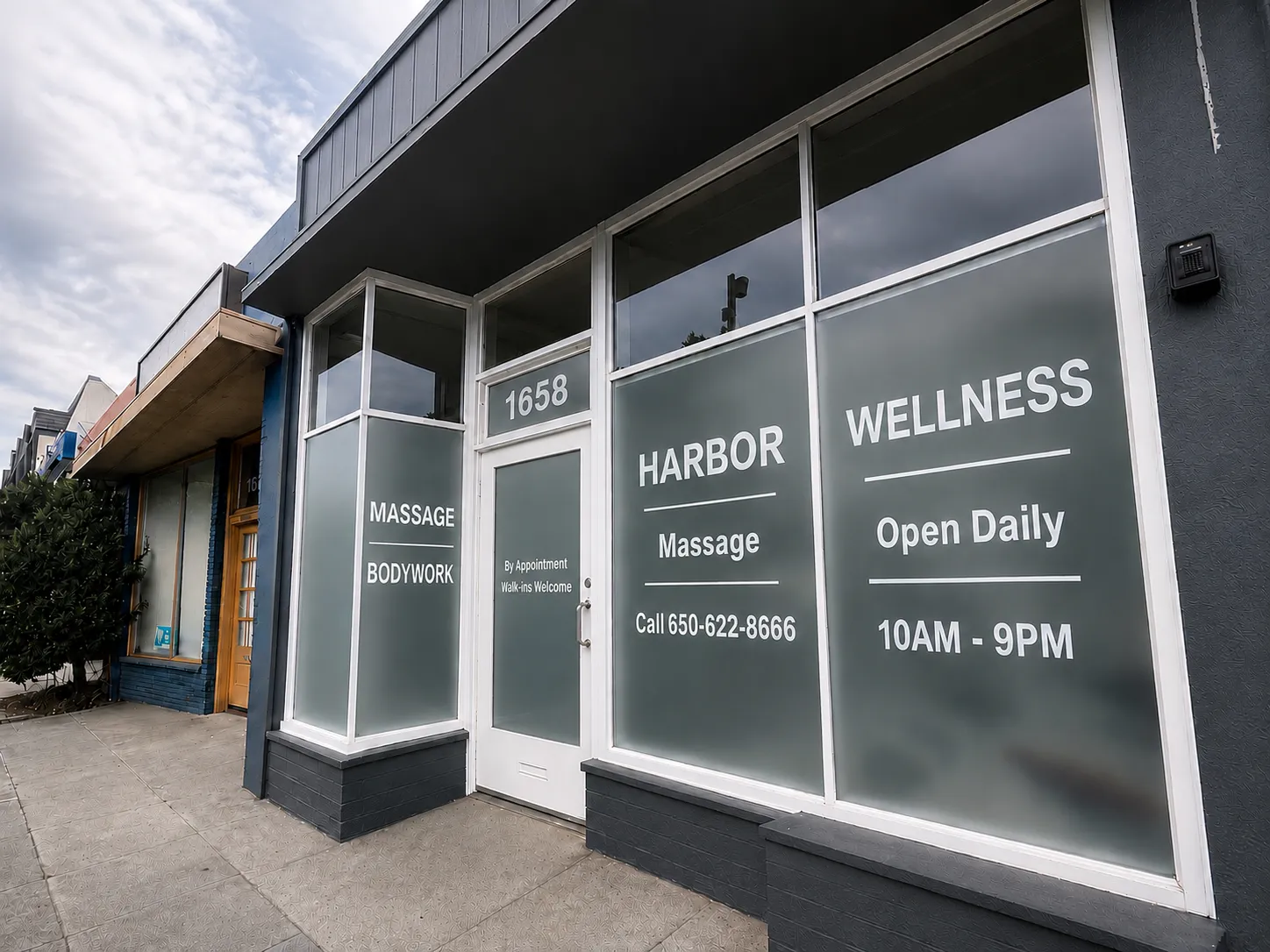
Harbor Wellness Massage · 1658 El Camino Real, San Carlos, CA 94070 · (650) 622-8666 · Open daily 10 AM – 9 PM.
Keep reading
Choosing the right therapist
Credentials, questions to ask, and why training matters more than technique.
Read
Chronic pain and complementary care
How massage fits alongside — never instead of — standard medical treatment.
Read
About our studio and therapists
Who we are, how we work, and what to expect when you visit.
Read